A few weeks ago, I attended the National Management Association’s annual conference in Reno, Nevada. As an officer on the national board of directors and a member of my company’s local chapter, the organization has become central to my professional growth and leadership journey. The week was productive, filled with meetings, networking, and new ideas. In this post, I’ll highlight some of my favorite moments.
The first part of the week focused on board meetings. I always enjoy connecting with board members and collaborating to make key decisions to further the association. In my current role as board treasurer, I am learning about the importance of maintaining organizational budgets and making important recommendations to the NMA staff on where we can reduce costs. I also work with the other officers and the staff to review existing processes and identify opportunities for revisions and improvements. Some decisions are straightforward, such as changing language that reflects our move to more virtual meetings. Others require further discussion that brings recommendations to the full board for a vote. I am honored to be a part of this board and the relationships I’ve built as well as the lessons learned.
After the board meetings, the conference officially kicked off Wednesday night with a mixer. I reunited with people I hadn’t seen in about a year and made some new connections. The next day, professional development sessions began. Here are some insights I gained from the speakers:
Shawn Harper, former NFL player and now CEO of American Services and Protection, talked to us about having the mindset to win. Sharing personal stories and key principles, he encouraged us to think differently and enter a new level of motivation with the belief that we can win and not let our comfort zone and excuses prevent that from happening. One of the most profound things Shawn said that stuck with me was “If you’re not careful, your comfort zone will become your casket.” While that may sound harsh, it said to me that you have to be willing to take risks and not keep doing the things that are easy and normal. That could lead to your own demise.
Ana Larrea-Albert, speaker, author, leadership strategist, and just beginning her doctoral journey, was our next speaker. She engaged us in activities to help us consider a new perspective that points us towards excellence. We were challenged to shift our mindsets to find the positive even in situations that don’t seem that way. While she gave some examples, the session was more hand-on as we explored situations individually and in our table groups to look at challenges through a more positive lens. She brought together the elements of strength, mindsets, values and purpose that lay the foundation for confident leadership and how to identify the self-limiting beliefs that we often go to as a means of protection. One thing Ana shared that stood out to me was that when dealing with those self-limiting beliefs, we should “look at them with kindness and compassion,” which then allows us to give the same to others.
John Di Domenico, keynote speaker, actor, and impressionist gave us two amazing experiences by hosting our annual Recognition brunch and giving a keynote session during the conference. His creativity and spontaneity led to a special moment of some attendees sharing why historical leaders resonated with them. Because of this, many of us learned about leaders we didn’t know before and heard some heartfelt stories of individuals that inspired others to explore leadership. In his keynote, John shared his life journey of discovering his voice and challenged us to embrace the most underrated asset we have in our voice. For leaders, this is an important element that we don’t often think about, so it was great to have John challenge and help us consider ways to bring our voices forth.
A special treat during the conference a session led by They Improv. Several years ago, I participated in a team building activity at Grand Circus. There, we used improv to practice conversations with others and consider the importance of having to use these techniques to confidently present to others and to lead critical and sometimes uncomfortable discussions to point employees and teams to success. I had forgotten about this experience until my son had a school event with Karen and Darrin, a local couple who shared their gift of improv, storytelling, and illustration. Knowing how amazing of an approach this can be for leadership development, I shared the idea with the organization staff, and they were able to get They Improv on the schedule. The group was very hands-on, and we got a lot of practice on how to apply improv to our work conversations and decision making.
We also had the pleasure of learning from two of our NMA members. Larry Kieshnick brought an interactive session on understanding our own and other’s personalities, gleaning on components of Carl Jung’s Four-Color Framework and Don Lowry’s True Colors system. By identifying our primary profiles, we collaborated in groups to confirm how we think and work with others, then gaining understanding on the other colors in an effort to work better together. David Sandhu built on his past webinars on AI and introduced a new series on prompting. It was great to hear a more effective way to have AI assist with requests and the importance of “being more human in the age of AI.” One of my biggest takeaways from the session was reminder of having AI ask questions to help better understand the need. I’ve applied that suggestion to several AI interactions in the past week and have found the results more refined and useful.
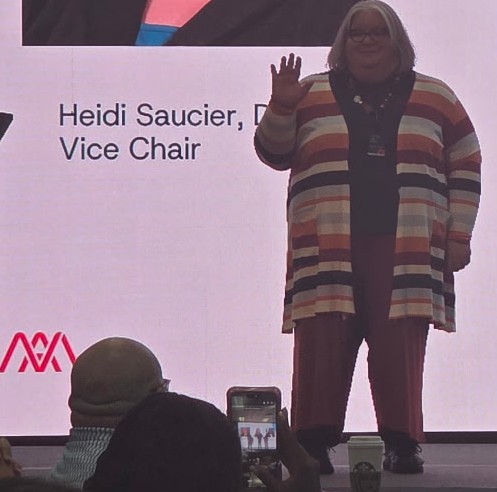
In addition to the speakers, we celebrated the accomplishments of our chapters over the past year. Many chapters achieved milestone anniversaries as chapters, recognition for membership growth, and awards for their overall programs and publications. We also honored Dan Gilbert as of Hall of Fame Recipient, Colin Catto as our Member of the Year, and Dr. Tahllee Baynard of Lockheed Martin as our Executive of the Year. I also was sworn in as our 2027 Vice-Chairperson along with our other incoming officers. I’m honored to continue to lead our board of directors next year and beyond.
In a full and productive week, I am grateful for the networking, learning, and celebration that took place in Reno. As we now move forward as the Human Skills Network, I am encouraged by where NMA is going and the potential it will bring to current and upcoming leaders in the years to come. If you are looking for an opportunity to cultivate your leadership development, the National Management Association is an organization to consider joining. If you’re interested, I encourage you to check out the website or reach out to me for more information. What was the most recent conference or workshop that brought new insights on leadership to you? Share in the comments!